
Datos personales

Mi foto
Fundador y managing partner de Innovative Bioconsulting, una consultora dirigida a empresas biotecnológicas. Profesor de Gestión Empresaria en el Máster de Biotecnología de la Escuela de Negocios Aliter, Madrid, España. Tutor de Emprendedores de IE Business School. Anteriormente ha desarrollado su carrera profesional en el sector biofarmacéutico, con experiencia multinacional y creación de dos empresas. Master en Biotecnología y MBA
Mostrando entradas con la etiqueta financiación biotecnología. Mostrar todas las entradas

lunes, 21 de enero de 2013

Are VCs still investing in Biotech? / ¿Invierte todavía el Capital Riesgo en Biotecnología?


En castellano más abajo
According to The Money Tree, (a collaboration involving the National Venture Capital Association and PricewaterhouseCoopers with data provided from Thomson Reuters), the biotech industry received $4,1 billion in 2012, slightly above what was invested in 2010 but worse than $4,9 billion invested in 2011. The second quarter of the last year was especially bad in investment for all the industries. The Euro crisis probed to be a good argument to delay investment decisions. Money is always coward when uncertainty hits the market.
However, the second half of the 2012 was much better although an increased activity that had a lot to do with the top deals in the pack. And that fits into an overall trend expected to play out in 2013, as most venture players continue to focus on later-stage deals largely reserved for a pack of seasoned entrepreneurs.
So the trend will be investing in Phase III companies expecting a return in three years and getting a big profit. That means that the number of investors is going down, they are larger and more professionalized. Bad news for the small struggling biotech firms that will face harder times in raising funds.
The good news: biotech is still seen as an attractive industry that got the most of the investments just after software. If we look at the combined figures of the medical devices companies and biotech industry, they account for 25% of total investment! Not bad.
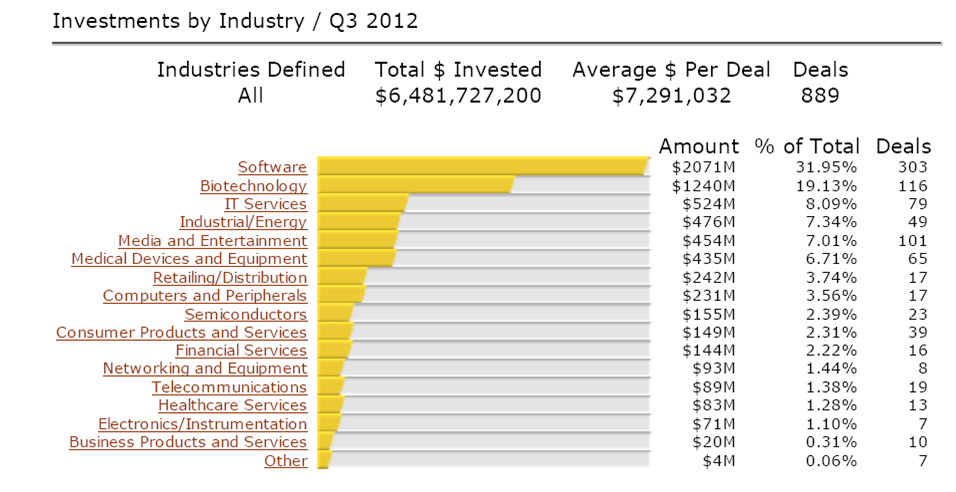
Investements by industry Q3 2012 / Inversión por sectores, tercer trimestre 2012. Source: PwC The Money Tree

Castellano
Se ha publicado recientemente un estudio sobre las cifras de inversión de capital riesgo llamado The Money Tree, patrocinado por PricewaterhouseCoopers, con datos de Thompson Reuters y la colaboración de la National Venture Capital Association. El sector biotecnológico ha recibido 4,1 millardos (miles de millones) de dólares en 2012, lo que es algo mejor que los 3,9 millardos de 2010 pero peor que los 4,9 millardos de 2011. La causa reside en que el segundo trimestre de 2012 fue especialmente malo debido, probablemente, a la crisis del Euro. El dinero siempre es cobarde cuando hay incertidumbre en los mercados.
Sin embargo, la segunda mitad de 2012 ha sido mucho mejor aunque el incremento de actividad tiene mucho que ver con grandes acuerdos firmados, lo que parece confirmar la tendencia para 2013 en que la mayoría del capital riesgo seguirá enfocándose en empresas con productos muy avanzados en su desarrollo lo que suele estar al alcance de unos pocos emprendedores veteranos
En fin, la tendencia es a invertir en Fases III, con un retorno de inversión esperado en tres años y esperando beneficios altos. Esto significa que el número de los inversores en biotecnología se reduce, son cada vez más grandes y más profesionalizados. Malas noticias para las pequeñas y luchadoras biotecnológicas que van a enfrentarse a tiempos difíciles.
Las buenas noticias, la biotecnología es todavía un sector atractivo pora los inversores, justo después la informática (software). Si sumamos las cifras de inversión en dispositivos médicos y biotecnología, podemos ver que han conseguido el 25% del total de las inversiones. No está mal.

martes, 6 de septiembre de 2011

Financing biotech companies: the importance of MAB in Spain / Financiar las biotech: la importancia del MAB

FundsImage by HowardLake via Flickr
En castellano más abajo
[Note: MAB stands from Mercado Alternativo Bursátil – Stock Exchange Alternative Market- similar to Alternext. Monoclonal antibodies are quite important as well, but not for all biotechs ;-)]

We are living hard times in the biotech industry. Nowadays, it is becoming increasingly difficult to get money for almost every industry and, specially, for biotech companies. Credit crunch started two or three years ago and it is still present.

We can start this post reviewing the more popular financing ways for biotechs:

  1. Grants
  2. Private investors
  3. Angel investors
  4. Venture capitalists
  5. Bank loans
  6. Going public
Talking about grants, Governments in EU are facing public debt problems thus reducing expenses is capital for them. Spain and other countries have suffered a reduction in the amount of public funds available for grants, despite of the efforts of the Science Minister in this respect.
Capital is really conservative. When the economic forecast are, as we can see these days, uncertain investors prefer to put their money in safe places awaiting for a more clear vision on economy evolution. Private and angel investors are being very cautious before putting a dime in a new venture.
Venture capitalists are overwhelmed with towers of biotech business plan begging for money. In other words, competition is higher than never to get an investment in biotech which is taking down the companies’ valuation artificially. I read contradictory news about the VCs’ investment trend in last year and a half. Sometimes it’s been said that VCs are increasing their investments in biotech but, on my experience, that’s not true, at least in Europe. I don’t even think about going to the US to ask for investments in Europe…
Bank loans. I think that the readers of this blog don’t need any explanation. Simply, this is not an option nowadays for a biotech firm. It never was but now, that is more true than ever.
We just have one option available out of six: Going Public.
Really? Well, that appears to be the case. And this is not an easy option, especially for small emerging biotechs that are condemned to struggle in the competitive landscape of private investors and VCs…
Up to now, there are two Spanish biotech companies listed at MAB: Ab-Biotics and NeuronBiopharma. Good for them! Becoming a listed company is a strategic decision with many drawbacks as regulation is hard (but not as hard as it is for other "traditional" markets). Information should be provided to market regularly and the companies incur in extra expenses to accomplish all of the requirements inherent to being traded.
However, we cannot forget the added benefits: a traded company is required to be transparent for investors, what could attract new ones, and new funding strategies could be on place (PIPEs, selling newly-issued, discounted shares to existing shareholders, ATM strategy…).
As a conclusion, going public does not only permit the company to raise funds in the IPO, but also gives the company access to new fundraising tools unavailable to private companies. In my view, it is time for biotechs in Spain to start thinking on going public and being traded on the MAB as an alternative financing source.

Definitions:
PIPE (Private Investment in Public Equities): typically in a PIPE transaction, a small group of private investors led by a hedge fund and the firm's original venture capital (VC) backers purchase shares in a publicly held biotech that is often young and struggling to attract the attention of Wall Street analysts and large institutional investors like mutual funds and pension funds. I took the definition form Nice PIPEs at Nature Bioentrepreneur 

ATM (At The Market): ATMs involve selling shares into the market in small chunks, and while they can’t be used to raise a boatload of money, they can avoid the discounts and warrants that can make registered direct offerings and PIPEs unattractive. I found this definition here: BiotechFundraising Options for Those With No Options

Las empresas gestoras de capital riesgo están abrumadas con torres de planes de negocio biotecnológicos mendigando dinero. En otras palabras, la competencia para lograr fondos se ha vuelto más competida que nunca, lo que está llevando a la baja la valoración de las biotecnológicas artificialmente. Llevo año y medio leyendo noticias contradictorias sobre la inversión de capital riesgo. A veces se ha dicho que la inversión de capital riesgo en biotecnología se está incrementando pero, en mi experiencia, esto no es cierto, al menos en Europa. Ni se me pasa por la cabeza ir a EE.UU. para pedir dinero para inversiones en Europa…
Préstamos bancarios. Pienso que los lectores de este blog no necesitan ninguna explicación. Sencillamente, ésta no es una opción. Nunca lo ha sido, en realidad, pero ahora es más cierto que nunca.
En fin, que nos queda una sola opción de seis: salir a bolsa.
¿De verdad? Bueno, parece que esa es la situación, que no es fácil especialmente para biotecnológicas emergentes que están condenadas a luchar por inversores privados y capital riesgo…
Hasta el momento, hay dos empresas biotecnológicas españolas que cotizan el MAB: Ab-Biotics y Neuron Biopharma. Bien por ellas. Ser empresa cotizada es una decisión estratégica con muchos inconvenientes ya que la regulación es dura (aunque no tanto como para otros mercados “tradicionales”). Se debe informar regularmente al mercado y las empresas incurren en gastos adicionales para cumplir con todas las obligaciones inherentes a ser cotizadas. Sin embargo, no podemos olvidar los beneficios añadidos: una compañía cotizada es más transparente, lo que puede animar a nuevos inversores y, sobre todo, se pueden acceder a nuevas estrategias de financiación (PIPEs, venta de nuevas acciones descontadas a los actuales inversores, estrategia “at the market”,…)
Como conclusión, salir a bolsa no solo permite a la empresa levantar fondos en la oferta inicial de acciones, también permite acceder a nuevos instrumentos financieros no disponibles para empresas no cotizadas. Quizá es el momento de comenzar a plantearse la salida a bolsa para las biotecnológicas españolas… Y por eso es tan importante potenciar el MAB e incentivar a las empresas, ¡más que la financiación pública!
Enhanced by Zemanta